
Read about Janice's story at Coral House
Supporting residents to have their own voice and gain confidence in their own freedoms.
From the very beginning, the team made it their mission to truly get to know Janice - to learn her individual signs, interpret her communication, and understand her likes, dislikes, wants, and needs.
When Janice* moved to Coral House, we were made aware of the significant challenges she had faced in her previous placement. Numerous attempts had been made to enhance her quality of life, yet many opportunities to support her development had either not been taken forward or had not been successfully embedded.
One of the key goals identified was to support Janice to access a private speech and language therapy service and to begin developing her communication skills - a challenge the team at Coral House embraced wholeheartedly.
At that time, Janice’s verbal communication was limited to just a few words: ‘yes’, ‘no’, and a firmly expressed ‘yuck!’. However, what Janice did have was a remarkable ability to finger spell. Despite having to adapt her signs due to reduced finger movement, she could identify staff members by their initials, ask who was working the following day, and communicate in ways that required patience, curiosity, and commitment from those supporting her.
From the very beginning, the team made it their mission to truly get to know Janice - to learn her individual signs, interpret her communication, and understand her likes, dislikes, wants, and needs. This was not about expecting Janice to fit into existing systems, but about shaping support around her.
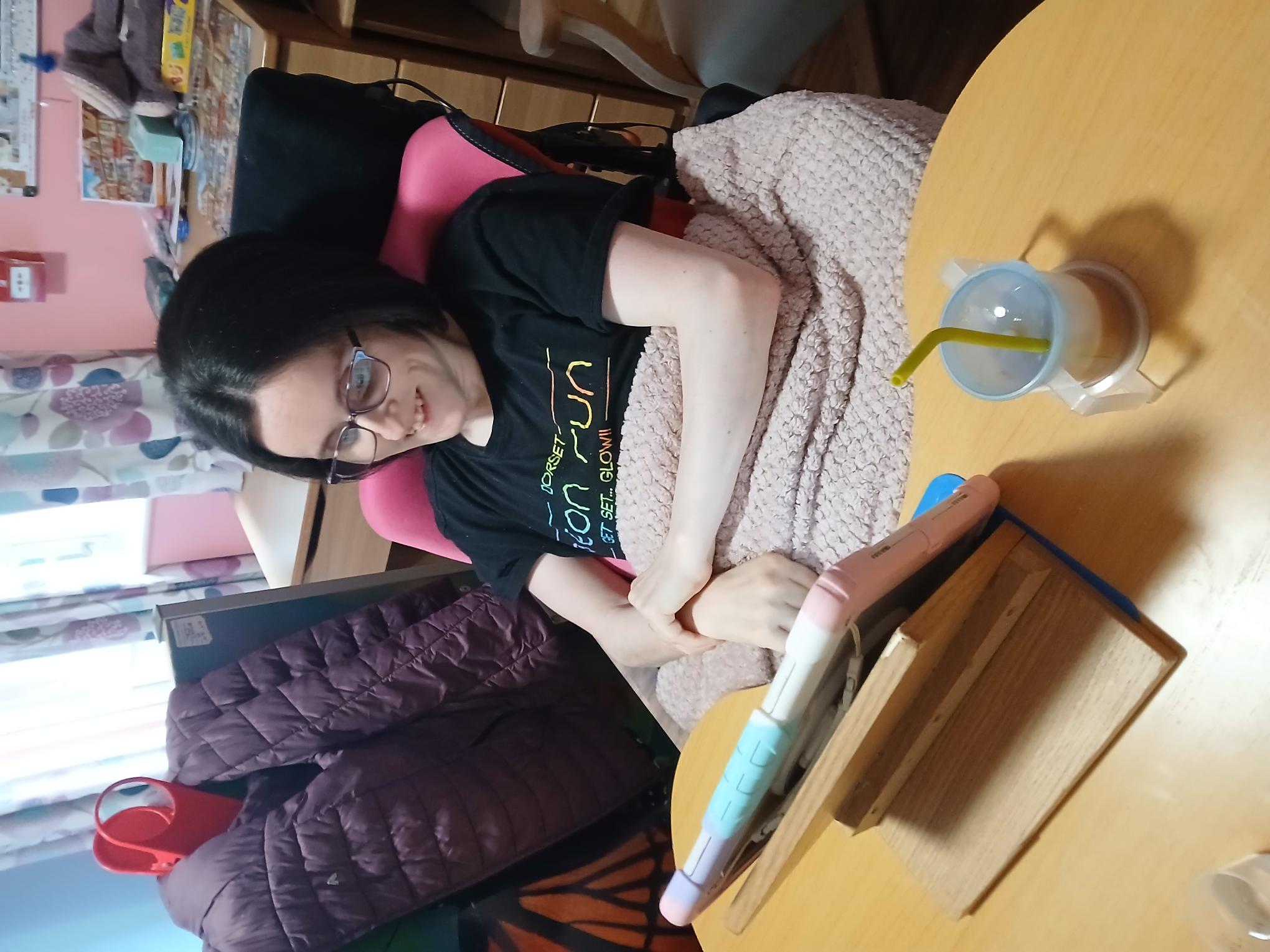
Shortly after her arrival, Janice’s speech therapy sessions began. Initially delivered remotely via Teams from a therapist based in Cardiff, sessions were accessed using Janice’s iPad and a communication app called The Grid, similar to Proloquo2Go.
The app began simply, with just a few carefully chosen tabs: photos and names of staff members, modes of transport (with the van and train quickly becoming favourites), colours of the rainbow, and parts of the body. Week by week, with patience, repetition, and encouragement, Janice learned to navigate the app and use it accurately.
As her confidence grew, so did the complexity of her communication. New tabs were added, enabling Janice to express autonomy and self advocacy - phrases such as: “I need to be repositioned”, “I need personal care”, and “it’s time to go”. She progressed to understanding and using prepositions, constructing short but increasingly complex sentences such as: “The cat is on the table.”
Now, almost three years on, Janice’s Grid app is rich with language and possibility. She takes genuine pleasure in asking staff what they did at the weekend, or asking her Nan what she did yesterday. She confidently requests drinks - and specifies exactly which one she would like. She is able to tell staff when something hurts and identify where, to say when she does not want to do something, or to ask for a preferred activity.
Janice delights in being able to request outings - asking to take the train, go out for lunch, or visit the shops - and is continuing to build her understanding of time by combining her Grid app with a pictorial weekly planner that helps structure and make sense of her week. She now routinely communicates using four to six word sentences, skilfully navigating multiple tabs to select the right words, people, and prepositions.
Janice’s therapy has quite simply opened her world.
For the first time in over 30 years, Janice has a reliable voice of her own. The communication skills she has developed have reduced frustration, significantly decreased behaviours that previously communicated distress, and removed the need for others to guess or misinterpret her needs.
Janice has gone from being a near silent woman to a lady of many words.
We could not be prouder - of Janice’s determination, resilience, and courage, and of the staff team who have learned, adapted, and grown alongside her to ensure her voice is heard, respected, and celebrated.
*Name changed